
Institute of Banking Studies Holds Workshop on Boards of Directors and Risk-Based Auditing
Deputy Central Bank Governor Dr. Khaldoun Al-Washah urged stronger governance, independent internal auditing and proactive risk management at a banking workshop in Jordan.
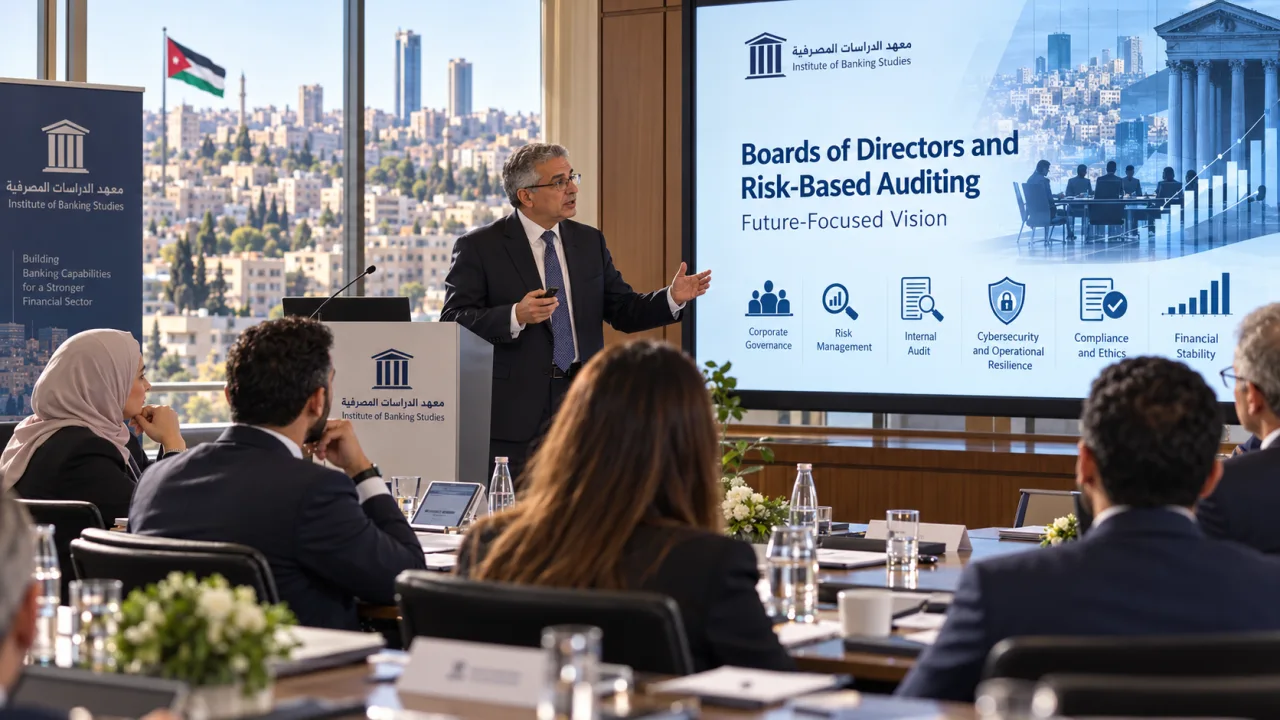
Amman, October 19 (Petra) — Deputy Governor of the Central Bank of Jordan Dr. Khaldoun Al-Washah stressed the importance of moving towards a more resilient and intelligent banking model, based on systematically anticipating emerging risks, the ability to foresee economic and technological changes, and addressing potential shocks before they occur, thereby strengthening the resilience and sustainability of the banking sector.
Speaking at a specialized workshop organized by the Institute of Banking Studies under the title "Boards of Directors and Risk-Based Auditing: A Forward-Looking Vision," with the participation of chairpersons and members of the boards of directors of a number of banks and financial-sector institutions, Al-Washah said that the unconventional challenges facing the modern banking environment, characterized by their speed, complexity and interconnectedness, require a reconsideration of approaches to handling risks and the development of corporate governance and institutional oversight tools.
He explained that rapid technological developments, the expansion of electronic banking services, the growth of cyber risks and climate-related financial risks, as well as the requirements for combating money laundering and terrorist financing, call for ambitious, forward-looking visions for the future of banking in Jordan. These must go beyond merely ensuring financial soundness and strength to building institutions capable of adapting to change and anticipating challenges.
He emphasized that achieving this vision rests on the integration of three main pillars: developing the legislative and supervisory framework in line with international best practices and standards; strengthening the strategic role of banks' boards of directors in establishing corporate governance, a culture of risk management and integrity; and activating risk-based internal auditing as a key tool for strengthening institutional oversight and improving operational efficiency.
Al-Washah affirmed that the independence of internal auditing is an essential condition for its effectiveness and its ability to add real value to banking and financial institutions. He noted that the Central Bank's instructions have given this aspect particular importance by strengthening the independence of internal audit units, linking them directly to audit committees and boards of directors, and ensuring that they have the resources and skills needed to perform their duties efficiently and in accordance with the latest international standards.
He pointed out that developing the internal audit framework is not limited to reinforcing traditional oversight tools, but also extends to establishing an institutional approach capable of proactively identifying and assessing risks. This supports financial institutions' ability to address changing challenges and maintain operational stability. He praised the Institute's efforts as the official training and development arm of the banking and financial sector, and its role in turning Central Bank initiatives into practical training programmes that help raise awareness and enhance the professional competence of staff in banking and financial institutions.
He noted that workshops of this kind provide an important platform for exchanging expertise and experiences, discussing future perspectives and reviewing best practices that have proved effective in strengthening confidence in banking and financial institutions and developing institutional working methods that improve their readiness to face future challenges efficiently and confidently.
For his part, Director of the Institute of Banking Studies Dr. Riyad Al-Hindawi said that the workshop was part of a series of specialized meetings that the Institute is keen to organize, with the aim of highlighting regulatory authorities' requirements and strengthening governance of the duties of boards of directors at banks and financial institutions.
He explained that the workshop focused on risk-based auditing as one of the principal areas for developing the internal control framework, strengthening the stability of banking and financial institutions and ensuring the sustainability of their operations in a financial and banking environment undergoing rapid changes and facing growing challenges.
The workshop forms part of efforts to establish sound banking practices and strengthen the integration of the oversight and supervisory roles of boards of directors and internal audit units. These efforts support the development of financial institutions that are better able to anticipate and manage risks, while preserving the strength of Jordan's banking sector and the confidence of those who deal with it.
-- (Petra) R.Sh. / A.S. / A.A.
News Feed
Profits from investments of the "Social Security Fund" have reached 12.1 billion dinars since its establishment.
Source: Jordan News Agency (Petra)
Source: Jordan News Agency (Petra)